Buddhism has one of the most carefully worked-out positions on what happens after death of any of the major religions. It is also one of the most commonly misunderstood. The short version: Buddhism teaches rebirth, not reincarnation, and the goal of practice is to be released from the cycle of rebirth altogether. This guide walks through what the tradition actually says, what it doesn't say, and where the major schools differ.
Buddhism does not teach a heaven you go to after a life of being good, or an oblivion you fall into after a life of being bad. It does not teach that an unchanging soul travels from one body to another. And it does not teach that death is the end. It teaches something more interesting and a bit harder to grasp: a continuity of process without a continuous self.
When a person dies, the stream of consciousness conditioned by their actions does not simply stop. It conditions a new arising. That new arising can be in any of six realms, depending on the karma that drives it. The new being is neither the same as the old one nor entirely different. It is what arises from those conditions, the way a flame on a new candle is neither the same flame as the one that lit it nor a different flame entirely.
The aim of the Buddhist path is not to secure a good rebirth, though that is a side effect of ethical practice. The aim is to bring the entire cycle to a stop by uprooting the craving and ignorance that keeps it going. That cessation is called nirvana.
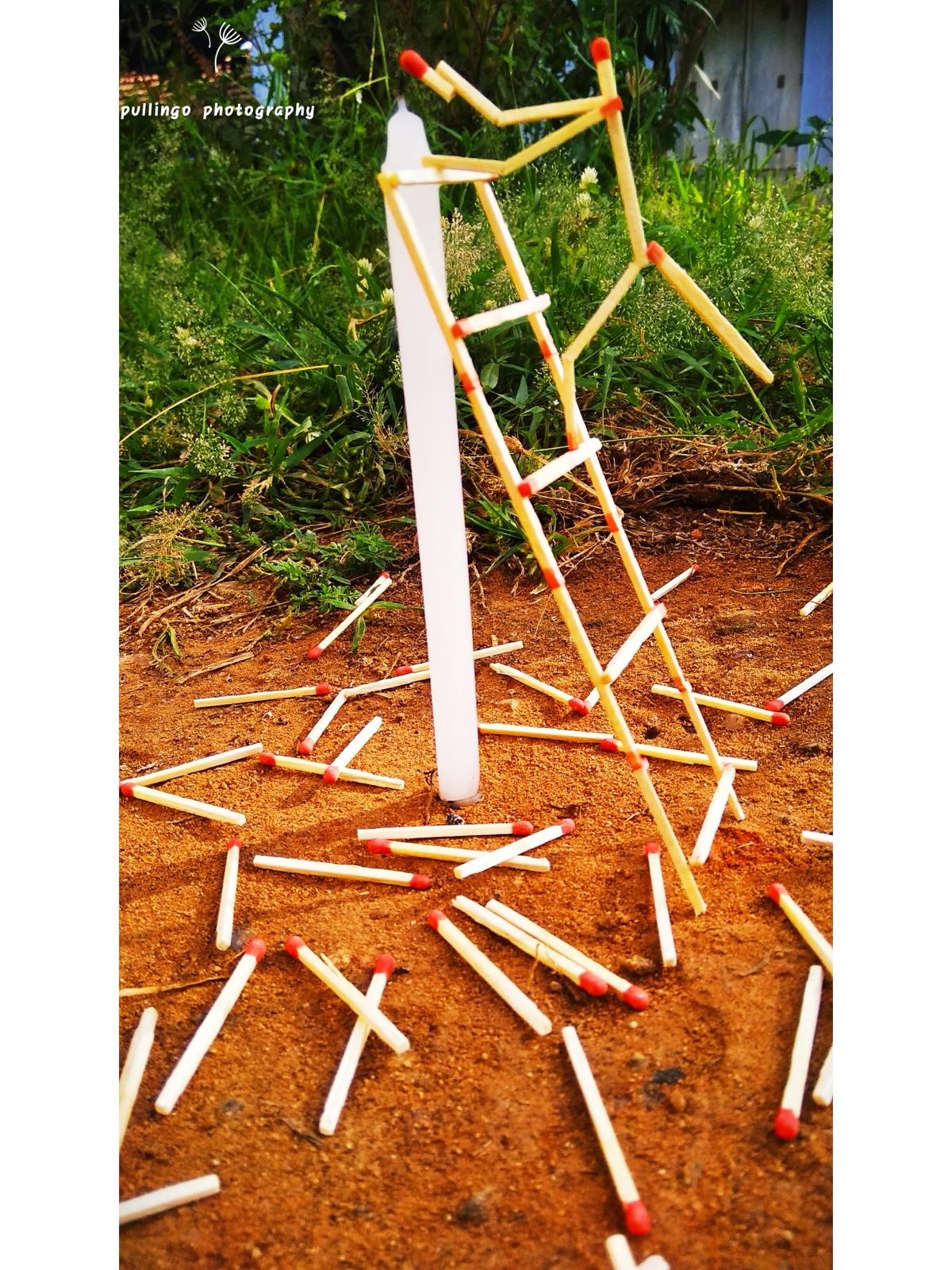
1. Rebirth, not reincarnation
Photo: Vignesh3597, CC BY-SA 4.0, via Wikimedia Commons.
The most common misreading of Buddhism is that it teaches reincarnation, where a permanent soul leaves one body and enters another. It does not. The doctrine of anatta, or non-self, explicitly denies any permanent essence that could transmigrate. There is no soul to be reborn.
What is reborn, in the Buddhist account, is a stream of conditioned phenomena. The classical metaphor is a candle: when one flame lights another, the new flame is neither the same as the first nor a wholly separate flame. It arises from conditions the first flame supplied. Rebirth is closer to that. The new life is conditioned by the previous one, carries forward its karmic momentum, but is not the same self looking out of new eyes.
2. Karma is the engine
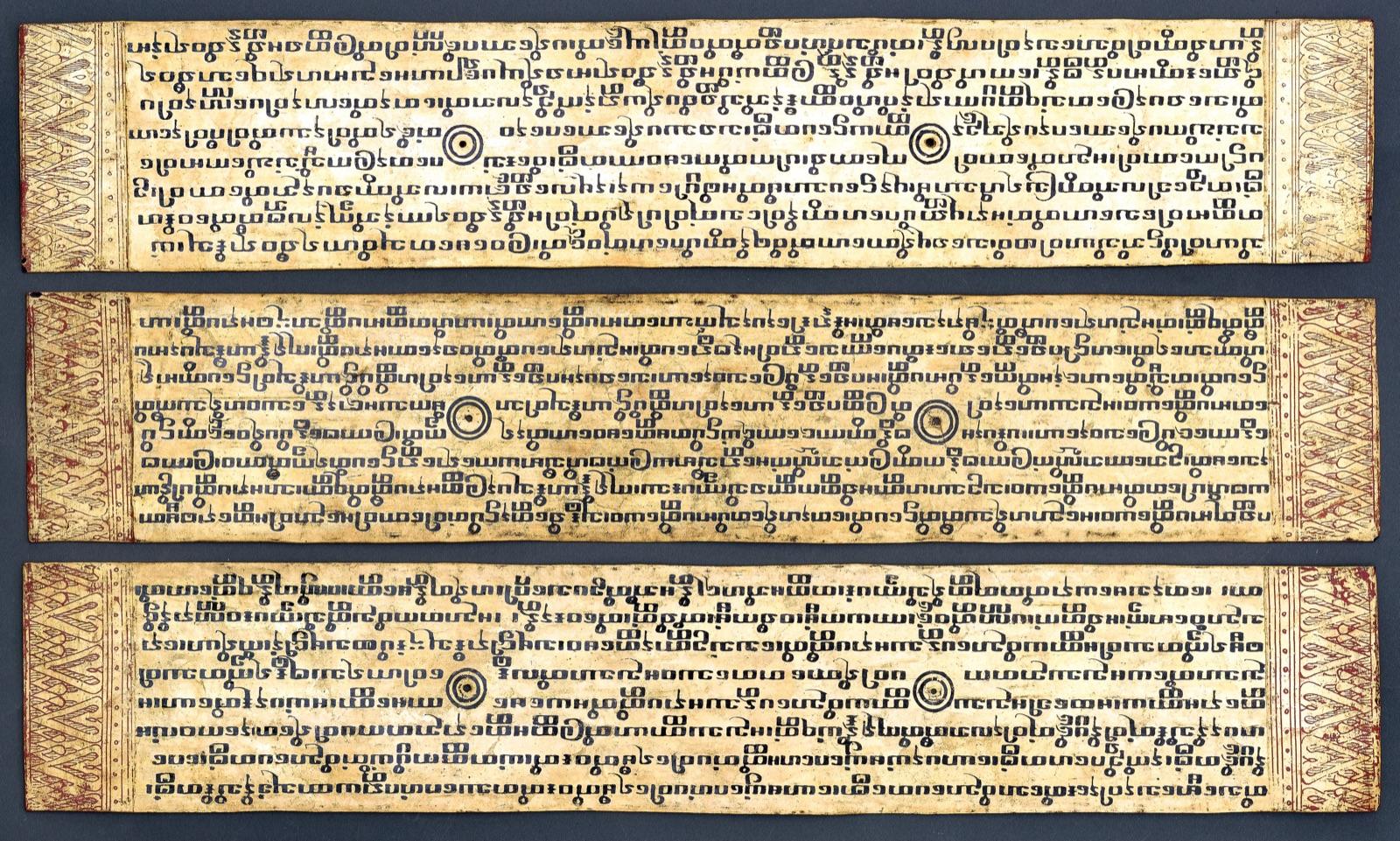
1856 Burmese manuscript, public domain, via Wikimedia Commons.
Karma in Buddhism is not divine reward and punishment. It is causality applied to intention. Every volitional action of body, speech, or mind leaves a trace, what the Pali texts call a sankhara, a formation. Those formations accumulate, condition future states of mind, and at the moment of death they shape what arises next. Wholesome actions tend toward favourable rebirths. Unwholesome ones tend the other way.
Importantly, no one is keeping score. There is no judge, no afterlife court. The mechanism is impersonal, like gravity. This is a feature of the doctrine, not a flaw. It means responsibility for what comes next sits squarely with the actions taken in this life. Buddhist ethics is not 'be good so a god will reward you'. It is 'your actions condition the world, including the part of it that becomes you'.
3. The six realms
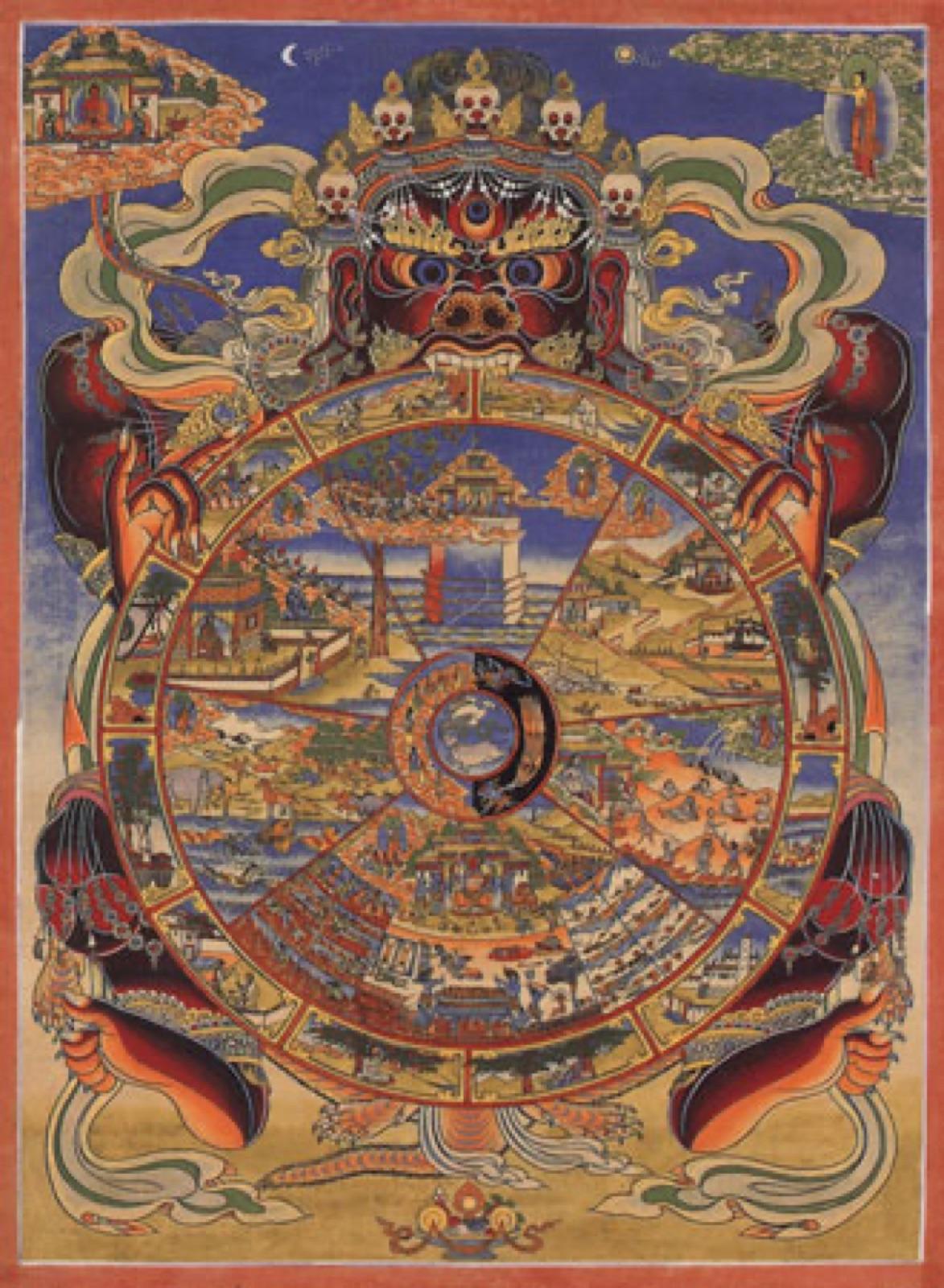
Tibetan thangka, public domain (PD-Art), via Wikimedia Commons.
Buddhist cosmology describes six realms into which beings can be reborn. From the most pleasant to the least: devas (gods), asuras (demi-gods), humans, animals, hungry ghosts (pretas), and hell beings. These are sometimes read literally and sometimes psychologically. Tibetan teaching often does both at once: the realms are real destinations, and they are also recognisable states of mind in this life.
Two notes that often surprise readers. The god realm is not the highest goal. Gods live long pleasant lives but are still inside the cycle, and when their merit runs out they fall. The human realm, by contrast, is considered the most fortunate for practice, because it has enough suffering to motivate the search for liberation and enough freedom to do something about it. The hell realms are temporary too. Nothing in samsara is permanent.
4. The intermediate state
Photo: Jessie Eastland, CC BY-SA 4.0, via Wikimedia Commons.
Different schools disagree about what happens between one life and the next. Theravada Buddhism, the oldest surviving lineage, generally holds that rebirth is immediate. Consciousness arises in the new realm at the same moment it ceases in the old one, with no gap. Some Theravada sources allow a brief intermediate moment but treat it as instantaneous.
Tibetan Buddhism teaches the bardo, an intermediate state that can last up to forty-nine days. The Bardo Thodol, often translated as the Tibetan Book of the Dead, is a guide read aloud to the dying and the recently deceased to help them navigate the visions of this state. The bardo teachings are detailed and specific, with stages, encounters, and practices for each phase. They have become some of the most widely read Buddhist texts outside Asia, partly because they treat death as a navigable passage rather than an ending.
5. Liberation, not a better seat
Photo: Claudio Lelli 2, CC BY-SA 4.0, via Wikimedia Commons.
Most religions present an afterlife as the reward of practice. Buddhism inverts this. The cycle of rebirth, samsara, is itself the problem. Even a heavenly rebirth is impermanent and is, in the long view, just another setup for falling. The aim of the path is not to secure better terms within the cycle but to step outside it.
The cessation of rebirth is called nirvana. It is not heaven, not annihilation, not a place. The Buddha was famously evasive when asked what nirvana is, on the grounds that the categories we use to describe existing things do not apply. What he was clear about is what it isn't: not the continuation of the self, not the destruction of the self, because there was no fixed self to begin with. Nirvana is the going-out of the fire of craving that kept the cycle running.
6. What happens to the practitioner at death
Photo: Bernard Gagnon, CC0, via Wikimedia Commons.
For someone who has practised seriously but not reached liberation, the answer is the standard one: rebirth conditioned by karma, in one of the six realms, with the practice carried forward as momentum. For an arhat or a Buddha, someone who has fully extinguished craving and ignorance, the cycle does not continue. There is no rebirth. What happens 'after' such a being's death is not a question Buddhism answers in conventional terms, because conventional terms presuppose something the teaching has dissolved.
For everyone else, the practical takeaway is what the tradition calls maranasati, the recollection of death. Death is certain, the time of it is uncertain, and the conditions you bring to that moment matter. Maranasati is not morbid. It is the most practical way the tradition has of clarifying priorities.
Practice
A short contemplation: maranasati
The Buddha taught the recollection of death (maranasati) as a practice for clarifying what matters. Try this once a week, perhaps before sleep.
Sit or lie down comfortably.
Bring to mind, plainly, that you will die. Not soon necessarily, but certainly.
Notice what comes up. Anxiety, calm, distraction, regret, anything.
Don't change the response. Just see it.
Ask yourself: given this, what actually matters about today?
Sit with whatever answer arises. Five minutes is enough.
Common assumptions vs Buddhist teaching
Situation
Modern reflex
Buddhist response
What survives death
A soul, the same person, going somewhere.
A stream of conditioned phenomena, no permanent self.
Where you go
Heaven or hell, fixed by judgement.
One of six realms, conditioned by your karma.
Who decides
A god, a court, a deity.
No one. Karma is impersonal causality.
The goal
A good afterlife.
Liberation from the cycle altogether.
Stories that include the Buddha's own teachings on death
The Siddhartha app reads aloud key passages from the Buddha's life, including teachings on death, impermanence, and liberation. Each story comes with ambient sound and a sleep timer.
Yes, but not in the way most Western readers expect. Buddhist cosmology includes god realms (deva lokas) and hell realms (naraka), but both are temporary. Beings are reborn into them based on karma and leave when that karma is exhausted. There is no permanent heaven and no permanent hell. The goal of the path is not to reach heaven but to exit the cycle of rebirth altogether.
What is the difference between rebirth and reincarnation?
Reincarnation usually implies that a permanent soul moves from one body to another, keeping its identity. Buddhism explicitly rejects this, because the doctrine of anatta (non-self) denies that there is a permanent soul to begin with. Rebirth in Buddhism is the continuation of a stream of conditioned phenomena, like one flame lighting another, without a fixed entity that travels.
What is the bardo?
The bardo is the intermediate state between death and rebirth in Tibetan Buddhist teaching. It can last up to forty-nine days and contains specific stages, visions, and choices. The Bardo Thodol (the Tibetan Book of the Dead) is the most famous text describing it. Theravada Buddhism does not teach a long intermediate state; in that lineage, rebirth is immediate or near-immediate.
Do Buddhists believe in souls?
No. The doctrine of anatta, or not-self, is one of Buddhism's defining teachings. There is no permanent, unchanging essence inside a person that survives death. What appears to be a self is a continually changing process of body, feeling, perception, mental formations, and consciousness. Rebirth happens because of conditioning, not because of a soul.
Is nirvana the same as heaven?
No. Heaven, in Buddhist cosmology, is a temporary realm within the cycle of rebirth. Nirvana is the cessation of the cycle. The Buddha refused to describe nirvana in positive terms because the conventional categories used for existing things do not apply to it. It is not annihilation, not a place, and not the continuation of a self.
What does Buddhism say about ghosts?
One of the six realms is the preta or 'hungry ghost' realm. Beings reborn there are described as having huge appetites and tiny throats, condemned to crave without satisfaction. Like all the realms, this is sometimes read literally and sometimes psychologically as a state of unbroken craving. Modern Buddhist teachers often emphasise the second reading.
Does karma decide everything that happens to me?
No, and this is a common misreading. Karma is one cause among many. The Pali Canon explicitly distinguishes karma from biological, physical, and circumstantial causes. Not every event in your life is the result of past karma. Karma sets up tendencies and conditions, but the present moment is also shaped by current actions, environment, and others' choices.